JMCQUARRIE.co.uk
James McQuarrie - Helping founders and product teams understand what to build before they build it.
The gap between knowing and acting
Last week I shared an article by James Chudley introducing his concept of “Webstripes”.
If you’ve not come across it, the basic idea is quite simple. Webstripes attempt to visualise the environmental impact of a digital experience in much the same way that heatmaps help us visualise user behaviour. By making something largely invisible visible, they create a new way of looking at a product.
My initial reaction was that the idea was interesting because it made environmental impact visible.
The more I’ve thought about it, the less convinced I’ve become that visibility is actually the interesting part.
That probably sounds odd. After all, the entire premise of Webstripes is built around visualising something that is normally hidden from view. Surely visibility is the point?
Maybe.
But I found myself thinking about a story James shared in response to the LinkedIn discussion that followed.
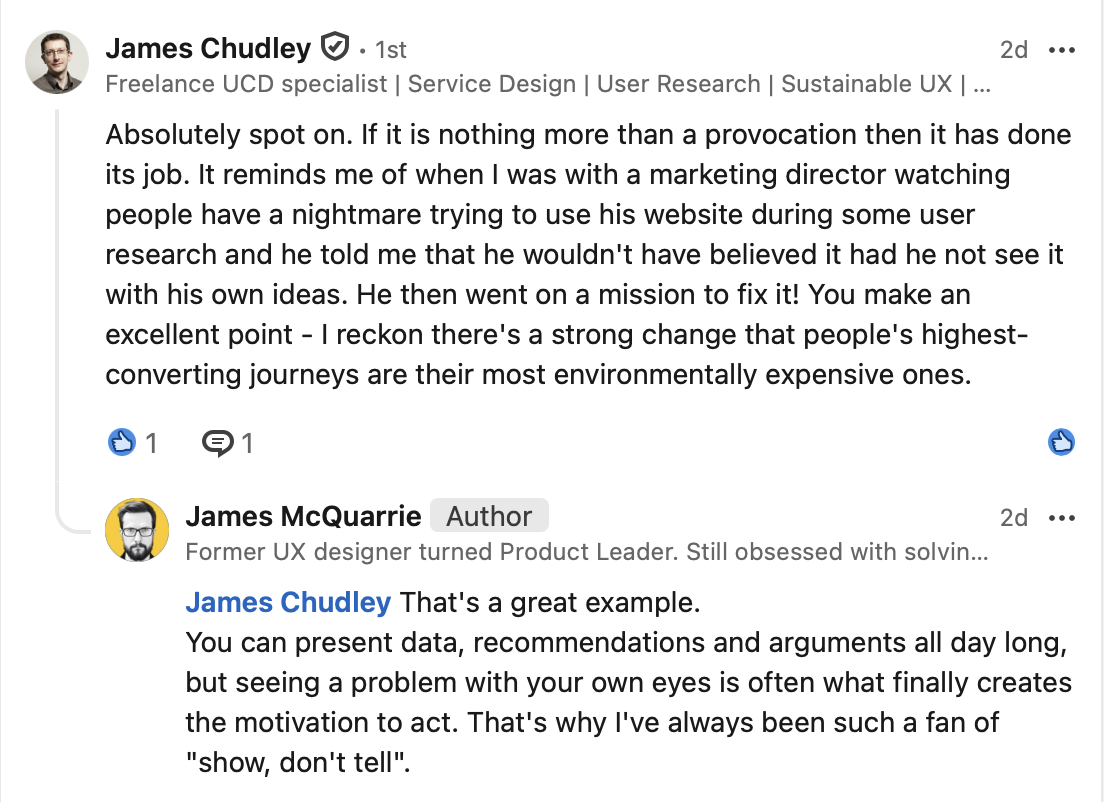
He described watching a marketing director observe a usability testing session. Users were struggling to complete tasks on the director’s website. According to James, the director later admitted that he wouldn’t have believed there was a problem had he not seen it happen with his own eyes.
I’ve spent enough time around user research to know that moment well.
It’s surprisingly common to watch a stakeholder move from scepticism to conviction over the course of a single research session.
What’s interesting is that the stakeholder rarely learns anything entirely new.
More often than not they already suspected there might be a problem.
They just weren’t convinced.
And I think that’s a different thing altogether.
For most of my career I’ve worked in environments where people are trying to make decisions under conditions of uncertainty.
Sometimes that’s a product decision. Sometimes it’s a pricing decision. Sometimes it’s a strategic decision.
The specifics vary, but the pattern is remarkably consistent.
A team suspects that something might be true; a customer journey feels clunky, a pricing model feels wrong, a market opportunity looks promising.
Nobody is completely ignorant of the issue. The problem is that there isn’t yet enough confidence to justify action.
Which is where I started thinking about one of my favourite principles: show, don’t tell.
I’ve always liked the phrase, but I’m not sure I’ve fully appreciated why it works. I used to think it was primarily a communication principle. Now I wonder whether it’s really a decision-making principle.
Telling somebody there is a problem invites debate.
Showing them creates evidence.
The distinction matters.
When we tell, we’re often asking people to trust our interpretation. When we show, we’re helping them build their own.
That doesn’t mean the evidence is perfect. User research is rarely statistically significant. Experiments are often imperfect. Data can be incomplete. Visualisations can oversimplify.
Yet somehow those moments still have the power to shift organisations from discussion to action, like in James’ example.
Perhaps because the goal was never certainty, but confidence?
The more I think about it, the more I wonder whether many organisations have an awareness problem at all. Most teams already know where their challenges probably lie.
They know there are usability issues somewhere in the customer journey. They know there are opportunities hidden within their pricing model. They know some parts of their product create more value than others. They know their digital services have an environmental impact.
What they often lack is sufficient confidence to act.
That feels like a subtle distinction, but an important one.
It changes the role of discovery, research and experimentation. The objective isn’t simply to uncover knowledge. It’s to generate enough evidence that a decision becomes easier to make.
Which brings me back to Webstripes.
The thing I find most interesting about the idea isn’t whether it perfectly measures environmental impact.
It’s whether it helps organisations move from:
“We should probably think about this.”
to:
“We need to do something about this.”
Because in my experience, that’s where change actually begins.
Not when people learn.
When they become convinced.